Picture this: you’ve just spent $500 on ads to acquire a new customer. They browse your store, add items to their cart, and finally complete a purchase worth $200. You feel great. But then, they never come back. That $500 investment just became a loss, and you’re left scrambling to find more customers to fill the gap.
This scenario plays out thousands of times every day across e-commerce stores worldwide. The harsh reality? Customer acquisition costs have increased by 60% over the last five years, making every new customer more expensive than ever before. Meanwhile, online retailers maintain an average repeat customer rate of only 28.2%, meaning roughly 72% of your customers buy once and disappear.
The solution isn’t finding more customers. It’s keeping the ones you already have.
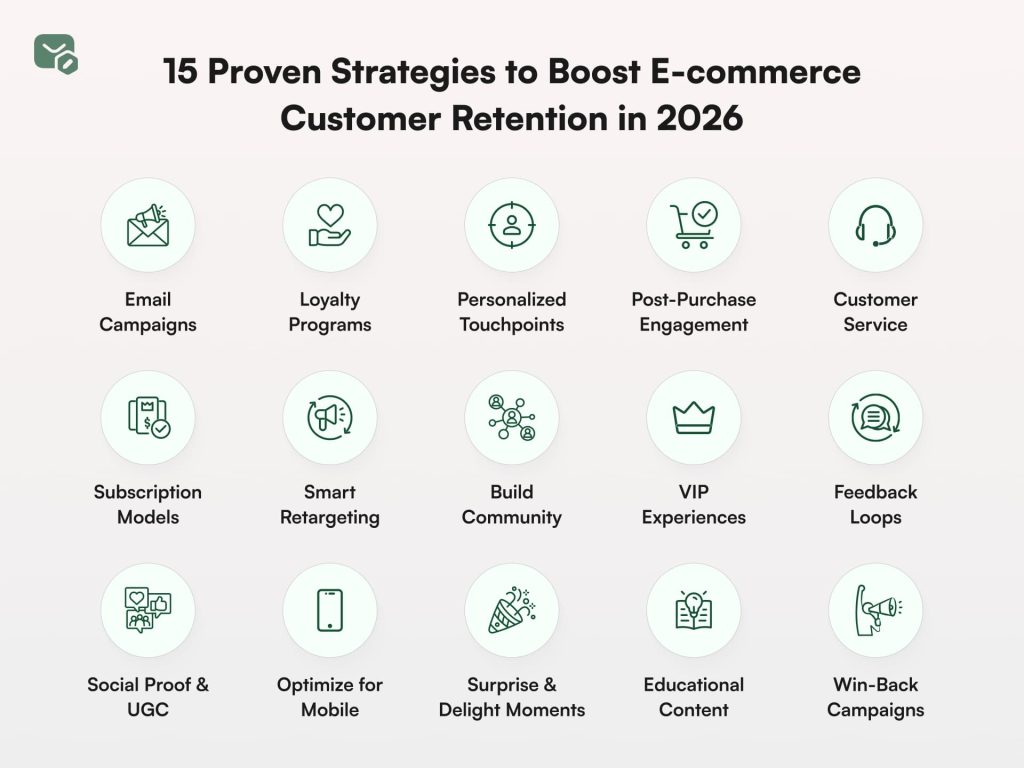
In this guide, you’ll discover 15 proven strategies to improve ecommerce customer retention that work in 2026. These aren’t theoretical concepts but practical, actionable tactics that successful online stores use to turn one-time buyers into loyal customers who generate predictable revenue month after month.
What is E-commerce Customer Retention?
E-commerce customer retention refers to your ability to keep customers coming back to make additional purchases over time. Rather than constantly chasing new customers, retention focuses on building relationships with people who’ve already bought from you.
The key metrics that matter include your repeat purchase rate, which shows what percentage of customers buy more than once, and customer lifetime value, which reveals the total revenue you can expect from a customer throughout their entire relationship with your brand. Most ecommerce brands average around 30% customer retention, though this varies significantly by industry and product category.
Here’s what makes retention different from acquisition: when someone buys from you the first time, they’re taking a risk. They don’t know if your products will meet their expectations, if shipping will arrive on time, or if customer service will respond when needed. After buying from your online store for the first time, a customer has a 27% chance of buying again. After a second purchase, there’s a 49% chance they’ll buy again.
Why Customer Retention Matters More Than Ever
Every dollar you invest in retention delivers significantly better returns than acquisition spending. The cost of acquiring new customers is five times higher than the cost of retaining existing customers. This gap continues to widen as digital advertising platforms become more crowded and competitive.
The financial benefits extend beyond lower costs. Existing customers tend to spend up to 67% more than new customers, and they require far less persuasion to make purchases. They already trust your brand, understand your products, and have experienced your customer service firsthand.
Market conditions in 2026 make retention even more critical. With an estimated 4.1 million live sites using Shopify and only 2.86% of ecommerce website visits converting into purchases, competition for customer attention has never been fiercer. You’re not just competing with direct competitors anymore; you’re competing with every online store, every marketplace, and every distraction vying for your customers’ limited attention and disposable income.
The math tells a compelling story: increasing customer retention rates by just 5% can boost profits by 25% to 95%. This isn’t a small improvement. It’s a fundamental shift in how your business operates and generates revenue.
15 Proven Retention Strategies for Online Stores
Retention isn’t about doing one thing perfectly; it’s about creating multiple touchpoints that consistently deliver value and build trust.
These 15 strategies work together to transform occasional buyers into loyal customers who choose your store over competitors every time.
1. Build Email Campaigns That Actually Convert
Email remains the most cost-effective retention tool available. 80% of small and medium businesses identify email as their most important retention tool, and for good reason. Unlike social media algorithms or paid advertising platforms, you own your email list.
Start with abandoned cart sequences that gently remind customers about items left behind. Three-email sequences recover 29% of abandoned carts versus 18% for single emails. Your first email should go out within an hour of abandonment, highlighting the specific products left behind. The second email, sent 24 hours later, can address common objections or offer social proof. The third email at 48 hours might include a modest incentive to complete the purchase.
Post-purchase emails deserve equal attention. Send a thank-you message immediately after purchase, a shipping confirmation with tracking details, and a follow-up asking for feedback once the product arrives. Then, based on what they bought, send targeted recommendations for complementary products.
Send automated order follow-up emails using Retainful’s easy-to-setup email automation.
2. Create Customer Loyalty Programs That Drive Behavior
83% of companies report positive loyalty program ROI with average returns of 5.2X. The key word here is “behavior.” The most effective programs don’t just reward purchases; they reward actions that strengthen the customer relationship.
Points-based systems work well for stores with frequent purchases. Customers earn points for every dollar spent, then redeem them for discounts or free products. Keep the earning ratio simple enough to understand at a glance and the redemption threshold low enough that customers see value quickly.
Tiered programs create aspirational goals that encourage increased spending. Bronze, silver, and gold tiers (or whatever naming convention fits your brand) offer progressively better benefits. Loyalty program members generate 12-18% more revenue than non-members, and premium tier members often spend even more.
Consider rewarding non-purchase actions too. Give points for writing reviews, sharing on social media, referring friends, or completing their profile. These activities build deeper engagement while providing valuable content and customer data.
If you’re running a WooCommerce store, a dedicated WooCommerce Points and Rewards plugin makes it easy to reward purchases and engagement with flexible point rules.
3. Personalize Every Touchpoint
Generic experiences no longer cut it. Customers expect brands to remember their preferences, anticipate their needs, and tailor communications accordingly. Companies that improve personalization efforts in loyalty programs can see up to a 10% growth in customer retention.
Start with product recommendations based on browsing and purchase history. If someone bought running shoes, show them running apparel, not basketball equipment. Use dynamic content in emails to display products relevant to each recipient’s interests and past behavior.
Personalize your homepage for returning visitors. Show them categories they’ve browsed, items related to previous purchases, or products similar to what they’ve viewed. This creates a feeling of familiarity and relevance that generic homepages can’t match.
Extend personalization to your customer service interactions. Train your team to reference past purchases and interactions, showing customers you remember their history with your brand. This attention to detail transforms transactional relationships into personal connections.
4. Master Post-Purchase Engagement
The moment after purchase is when most brands go silent, yet it’s one of the most important opportunities for building retention. Customers are excited about their purchase, emotionally invested, and highly receptive to further engagement.
Send a thoughtful thank-you message that goes beyond the standard order confirmation. Include tips for getting the most from their purchase, links to helpful resources, or information about your brand story. Make them feel good about their decision to buy from you.
Create unboxing experiences worth sharing. Include a handwritten note, branded packaging, or a small surprise gift. These details cost little but generate significant emotional impact and word-of-mouth marketing.
Follow up at strategic intervals. A few days after delivery, check if the product arrived safely and meets expectations. A week later, ask for a review. A month later, suggest complementary products or offer care tips. These touchpoints keep your brand top-of-mind during the crucial period when customers decide whether to return.
5. Deliver Exceptional Customer Service
93% of consumers are more likely to make repeat purchases at companies with excellent customer service. Service quality directly impacts whether customers stick around or move on to competitors.
Respond quickly to inquiries across all channels. Today’s customers expect near-instant responses, especially on platforms like live chat and social media. Set clear expectations for response times and consistently meet or exceed them.
Empower your support team to solve problems without requiring manager approval for every decision. Give them the authority to issue refunds, send replacements, or offer discounts when appropriate. This autonomy leads to faster resolutions and happier customers.
Transform problems into opportunities to impress. When something goes wrong, fix it quickly and generously. The way you handle issues matters more than the issues themselves. 78% will forgive a bad experience if the brand has excellent recovery.
6. Implement Subscription Models
Subscriptions create predictable recurring revenue while increasing customer lifetime value. Three-quarters of ecommerce businesses plan to offer subscriptions in the near future, recognizing the retention benefits.
Not every product suits a subscription model, but more do than you might think. Consumables like beauty products, supplements, or pet food work naturally. But even non-consumables can work with creative approaches like “surprise and delight” boxes or access-based subscriptions offering exclusive products or early access.
Make subscriptions appealing with meaningful discounts or exclusive perks that non-subscribers can’t access. Offer flexibility in frequency, allowing customers to skip shipments or adjust timing based on their needs. Remove friction from cancellation rather than making it difficult; paradoxically, easy cancellation increases trust and reduces actual churn.
Enhance every subscription touchpoint with beautifully customized emails using the Spark EditorWooCommerce Subscription Add-On.
7. Leverage Smart Retargeting
Not every visitor is ready to buy on their first visit, and not every customer remembers to return. Retargeting keeps your brand visible during the consideration period.
Use pixel-based retargeting to show ads featuring products customers viewed but didn’t purchase. These visual reminders often prompt returns, especially when paired with social proof or limited-time offers.
Create custom audiences for email-based retargeting on platforms like Facebook and Google. Upload your customer list to reach past buyers with retention-focused messages rather than acquisition ads. The targeting precision ensures you’re not wasting budget on people who’ve never heard of you.
Segment retargeting by customer value. Your highest-value customers deserve different messaging and offers than one-time buyers. Tailor your approach based on purchase history, average order value, and recency of last purchase.
8. Build Community Around Your Brand
Communities increase customer retention and decrease customer support costs. When customers feel part of something larger than a transactional relationship, they stick around.
Create spaces where customers can connect with each other. This might be a Facebook group, Discord server, or forum on your website. The key is facilitating conversations that go beyond product discussions to shared interests and values.
Feature customer stories and user-generated content prominently. When customers see themselves reflected in your brand communications, they feel recognized and valued. This social proof also helps convince new customers to make their first purchase.
Host events, either virtual or in-person, that bring your community together. These might be product launches, educational workshops, or casual meetups. The connections formed at these events strengthen emotional bonds with your brand.
9. Create VIP Experiences
Top-performing loyalty programs achieve 7.2X ROI through increased frequency, basket size, and reduced churn. Much of this success comes from making top customers feel genuinely special.
Identify your highest-value customers and create exclusive experiences they can’t get elsewhere. Early access to new products, private sales, or invitation-only events make VIPs feel valued and important.
Personalize communications at the highest level. Instead of automated emails, consider having your founder or a dedicated account manager reach out personally to your top customers. These human touches create memorable interactions that drive loyalty.
Offer concierge-level service to VIP customers. Priority customer support, free shipping on all orders, extended return periods, or dedicated phone lines show you value their business and are willing to invest in the relationship.
10. Use Customer Feedback Loops
Listening to customers isn’t just about fixing problems; it’s about showing you value their opinions and continuously improving their experience.
Send post-purchase surveys asking about their experience, but keep them short and focused. Three to five questions maximum, with a mix of rating scales and open-ended feedback options. Act on the feedback you receive and, when possible, let customers know their input led to specific changes.
Create a customer advisory board from loyal customers who provide ongoing feedback on new products, features, or initiatives. Compensate them for their time with exclusive perks or early access. This makes them feel like partners in your success rather than just customers.
Monitor social media and review sites for unsolicited feedback. Respond to both positive and negative comments, showing you’re listening even when not directly asked. This visibility demonstrates your commitment to customer satisfaction.
11. Harness Social Proof and User-Generated Content
86% of loyal customers will recommend the brand to their friends and family. Make it easy for them to do so while showcasing their advocacy to potential customers.
Create hashtag campaigns encouraging customers to share photos of your products in use. Feature the best submissions on your website, social media, and even in email campaigns. This provides authentic content while making featured customers feel proud and recognized.
Implement a robust review system and actively encourage reviews from happy customers. Reviews build trust with new customers while giving existing customers a voice. Respond to all reviews, especially negative ones, showing you care about feedback and continuously work to improve.
Launch referral programs that reward both the referrer and the new customer. Make sharing easy with one-click options and pre-written messages customers can personalize. Track which customers generate the most referrals and thank them appropriately.
12. Optimize Mobile Experience
Mobile commerce reached $4.5 trillion in 2024, representing 70% of eCommerce. Yet mobile experiences often lag behind desktop, creating friction that costs sales and retention.
Ensure your mobile site loads quickly and navigates intuitively. Simplify checkout to minimize form fields and steps. Implement mobile wallets like Apple Pay and Google Pay for one-touch purchasing.
Consider developing a mobile app if your customer base warrants the investment. Apps enable push notifications, which drive higher engagement rates than email. They also provide a more seamless, personalized experience that keeps your brand literally in customers’ pockets.
Test your mobile experience regularly from a customer perspective. Make purchases on different devices and operating systems to identify pain points before they cost you sales.
13. Create Surprise and Delight Moments
Unexpected positive experiences create emotional connections that transcend typical customer relationships.
Include small surprise gifts in orders occasionally. These don’t need to be expensive; the surprise itself matters more than the value. Sample products, stickers, or handwritten notes cost little but generate significant goodwill.
Send birthday or anniversary gifts to customers. A special discount or freebie on their birthday shows you see them as individuals, not just order numbers.
Randomly upgrade shipping for some customers, or throw in extra products. When customers receive more than expected, they remember and share those experiences with others.
14. Provide Educational Content
Position your brand as a helpful resource rather than just a store. Educational content builds trust and keeps customers engaged between purchases.
Create guides and tutorials related to your products. If you sell cooking equipment, publish recipes and technique guides. If you sell fitness products, share workout plans and nutrition advice.
Launch a blog that addresses customer pain points and interests related to your niche. This content improves SEO while providing value that keeps customers returning to your site even when they’re not ready to buy.
Develop video content that educates and entertains. Product demonstrations, behind-the-scenes looks, or expert interviews all build deeper connections with your audience.
15. Deploy Win-Back Campaigns
Even with perfect retention strategies, some customers will lapse. Win-back campaigns can reclaim a portion of these relationships before they’re lost forever.
Identify customers who haven’t purchased in longer than your typical purchase cycle. Create segmented campaigns based on how long they’ve been inactive and their previous purchase history.
Acknowledge the absence without being accusatory. Messages like “We miss you” or “It’s been a while” work better than “You haven’t ordered lately.” Focus on what’s new or what they’ve missed rather than dwelling on their absence.
Offer a compelling incentive to return, but make it about value rather than desperation. A percentage discount paired with free shipping often works well. Highlight new products or improvements they haven’t seen yet.
Measuring Your Retention Success
You can’t improve what you don’t measure. Track these essential retention metrics monthly to understand how your strategies perform.
- Repeat Purchase Rate: Calculate the percentage of customers who make more than one purchase. This fundamental metric reveals whether your retention efforts are working at a basic level.
- Customer Lifetime Value (CLV): Measure the total revenue you expect from a customer throughout their entire relationship with your brand. Increasing CLV means your retention strategies are driving more purchases and higher order values over time.
- Customer Retention Rate: Use this formula: [(Customers at end of period – New customers acquired) / Customers at start of period] x 100. This shows what percentage of your existing customer base continues buying from you.
- Time Between Purchases: Track how long customers typically wait between orders. Decreasing time between purchases indicates improving engagement and loyalty.
- Churn Rate: Measure the percentage of customers who stop buying from you over a specific period. High churn rates signal problems with your product, service, or retention strategies.
Compare these metrics against your historical performance and industry benchmarks. Most ecommerce brands average around 30% customer retention, though anything less than 25% suggests there’s a problem.
Use tools like Google Analytics, your ecommerce platform’s built-in analytics, and customer relationship management (CRM) systems to track these metrics automatically. Shopify Flow, Klaviyo, and Yotpo all offer robust retention tracking capabilities.
Common Retention Mistakes to Avoid
Even well-intentioned retention efforts can backfire if you make these critical mistakes.
- Over-Emailing Customers: Finding the right email frequency is crucial. Too few emails and customers forget about you. Too many and they unsubscribe or mentally tune out. Test different frequencies with segments of your list to find the sweet spot for your audience.
- Offering Generic Loyalty Rewards: Points and discounts work, but they’re not enough on their own. The key success factors include personalization (82%), gamification (67%), and experiential rewards (74%). Generic programs blend into the background while personalized experiences create memorable connections.
- Ignoring Negative Feedback: When customers complain, they’re giving you a gift: the opportunity to fix a problem and save the relationship. Over three-quarters of worldwide respondents (76%) said they would stop doing business with a company after just one bad experience. Respond quickly, fix issues generously, and learn from patterns in complaints.
- Focusing Only on Discounts: Competing on price alone creates a race to the bottom that erodes margins and attracts price-sensitive customers who’ll leave for a better deal elsewhere. Build retention through value, experience, and emotional connection rather than constantly discounting.
- Neglecting Customer Service Quality: 75% of customers will abandon a brand after two bad experiences. Customer service isn’t a cost center; it’s a retention investment that directly impacts your bottom line.
Maximize customer retention with Spark Editor’s personalization features and professional email templates built for repeat sales
Conclusion
E-commerce customer retention isn’t a single tactic or quick fix. It’s a comprehensive approach to building relationships that turn one-time buyers into loyal customers who generate predictable revenue year after year.
The economics are undeniable: retention costs less than acquisition, retained customers spend more, and small improvements in retention rates drive substantial increases in profitability. In an environment where customer acquisition costs have risen 60% over the last five years, prioritizing retention isn’t optional. It’s essential for sustainable growth.
The 15 strategies outlined in this guide provide a framework for building an effective retention program. You don’t need to implement everything at once.
Other Helpful Guides
Frequently asked questions
What is a good customer retention rate for ecommerce? A good customer retention rate for ecommerce typically ranges between 25-35%, though this varies by industry. Fashion and apparel brands often see rates around 30-40%, while electronics may see 20-25%. Premium brands and subscription-based businesses can achieve retention rates of 50% or higher.
How do you calculate customer retention rate in ecommerce? To calculate customer retention rate, use this formula: [(Number of customers at end of period – New customers acquired during period) / Number of customers at start of period] x 100. For example, if you started with 1,000 customers, gained 300 new ones, and ended with 1,100 total customers, your retention rate would be [(1,100 – 300) / 1,000] x 100 = 80%.
What are the most effective customer retention strategies for small ecommerce businesses? The most cost-effective retention strategies for small businesses include email marketing (particularly abandoned cart and post-purchase sequences), simple points-based loyalty programs, exceptional customer service, personalized product recommendations, and post-purchase follow-ups.
Should I offer discounts to improve customer retention? Discounts can be effective for retention when used strategically, but they shouldn’t be your only tool. Over-reliance on discounts trains customers to wait for sales and erodes profit margins. Instead, combine occasional strategic discounts with value-based retention tactics like exclusive early access, free shipping, exceptional service, personalized experiences, and VIP perks.
What metrics should I track to measure customer retention success? Track these essential metrics: repeat purchase rate (percentage of customers who buy more than once), customer retention rate (percentage of customers who continue buying over time), customer lifetime value (total revenue per customer), average time between purchases, churn rate (percentage of customers who stop buying), and Net Promoter Score (likelihood customers will recommend you).